

By : Ujala Umair
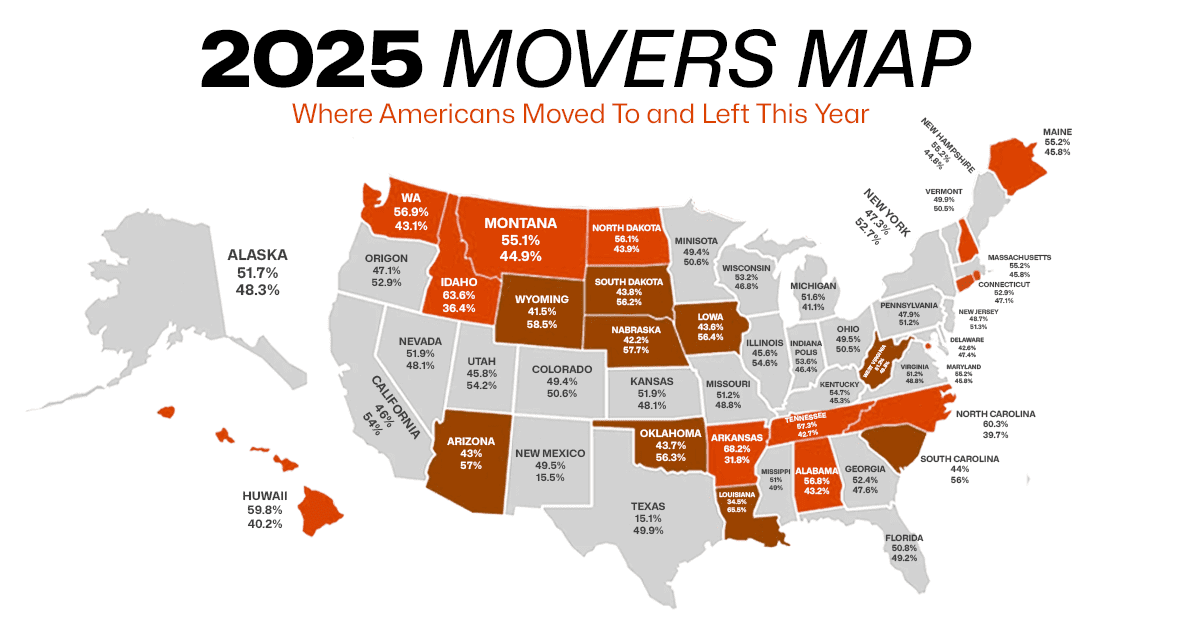
The Migration Patterns Study, which has been conducted every year since 1993, tracks quick shift customers’ interstate, interprovincial, and worldwide relocations. In order to determine where people migrated from and where they moved to, this year’s study tracks relocations from November 1, 2024, to October 31, 2025.
According to recent U.S. Census data, interstate movements in 2025 remained consistent with previous years. Despite this, general mobility is still low today, mostly because to financial limitations such as the high cost of property and a lack of inventory. The industry’s importance as a reliable facilitator of essential life and career transitions in the face of difficult market conditions is shown by the ongoing amount of interstate moves, even as the median age of first-time homebuyers rises and house sales slow.
In general, fewer Americans are relocating in 2025. Those who do are discovering that “everyone” no longer wants to travel to popular locations. Instead, as destinations find their trendiness wanes and spreads across a wider range of states, the window is narrowing and experiencing less upswing and downswing.
In general, fewer Americans are relocating in 2025.
Those who do are discovering that “everyone” no longer wants to travel to popular locations. Instead, as destinations find their trendiness wanes and spreads across a wider range of states, the window is narrowing and experiencing less upswing and downswing.
Which states are the majority of Americans leaving?
In 2025, the following U.S. states had the highest percentage of outward relocations:
- Sioux Falls, South Dakota, recorded the largest number of outbound moves by city, while Iowa, Nebraska, South Dakota, and Wyoming had some of the highest rates in the Great Plains. But for the second consecutive year, Louisiana was the top outbound state.
- Notably, California, Illinois, and New York—three of the five outbound states from 2024—have shifted to a balanced position. This illustrates the pervasive “lock-in effect,” where a large number of homeowners are opting not to relocate at all.
The threshold value, which is the total number of shipments
Multiplied by 0.55 (i.e., in a state with 100 moves, at least 55 must be outgoing to be classified outbound), determines the inbound/outbound status of each province and nation. The remaining states and provinces are categorized as balanced if neither inbound nor outgoing numbers are above the threshold. The report makes reference to both cross-border (from the United States to Canada) and Canadian interprovincial shipments.
People are relocating to and from states
All around the United States, people are planning to relocate in 2025, but the majority of survey participants—nearly 46%—plan to move to a Southern state. The only other region that has had a net increase in interested movers is the Midwest, albeit by a slim margin (just over 3%).
However, the West experienced a net decline in movers, with around 25% of respondents wanting to move to a Western state and about 30% wishing to leave the area. Additionally, more respondents said they would rather leave the Northeast states than relocate there.
The top ten states where people are relocating
The South is home to eight of the top eleven states in terms of net migration interest.
- With 2,208 more respondents thinking about migrating to the Tar Heel State than leaving, North Carolina tops the list for net gain. South Carolina is right behind them:
- Relocating to South Carolina is 83% more popular than leaving the state.
This year, Tennessee surpassed Florida to take third place. According to the most recent state-to-state migration data available, - Florida’s net domestic migration decreased by more than 49% between 2022 and 2023, albeit still being high in comparison to other states.
- According to Consumer Federation of America research, the average yearly premium for homeowners’ insurance in Florida is about $9,500, making it the most costly state. Rates increased by much to 102% in certain counties between 2021 and 2024.
- There are really 11 states in the top 10 ranking because Arizona and Arkansas are tied for net migration interest.
Why are so many people from New York and California relocating to the South?
Americans are moving to the South for a number of reasons, but for many, it comes down to money. According to Berube of Brookings, “the affordability ‘pull’ that many Sun Belt metro areas exerted before and after the pandemic’s onset is equally an unaffordability ‘push’ from the big coastal markets.”
California is the worst state for renters due to its high rent, and four of the five worst cities for first-time homeowners are in the Golden State. The cost of living in New York is still very high, even though the Empire State isn’t as concentrated at the bottom of these rankings as California, especially for housing.